Start here
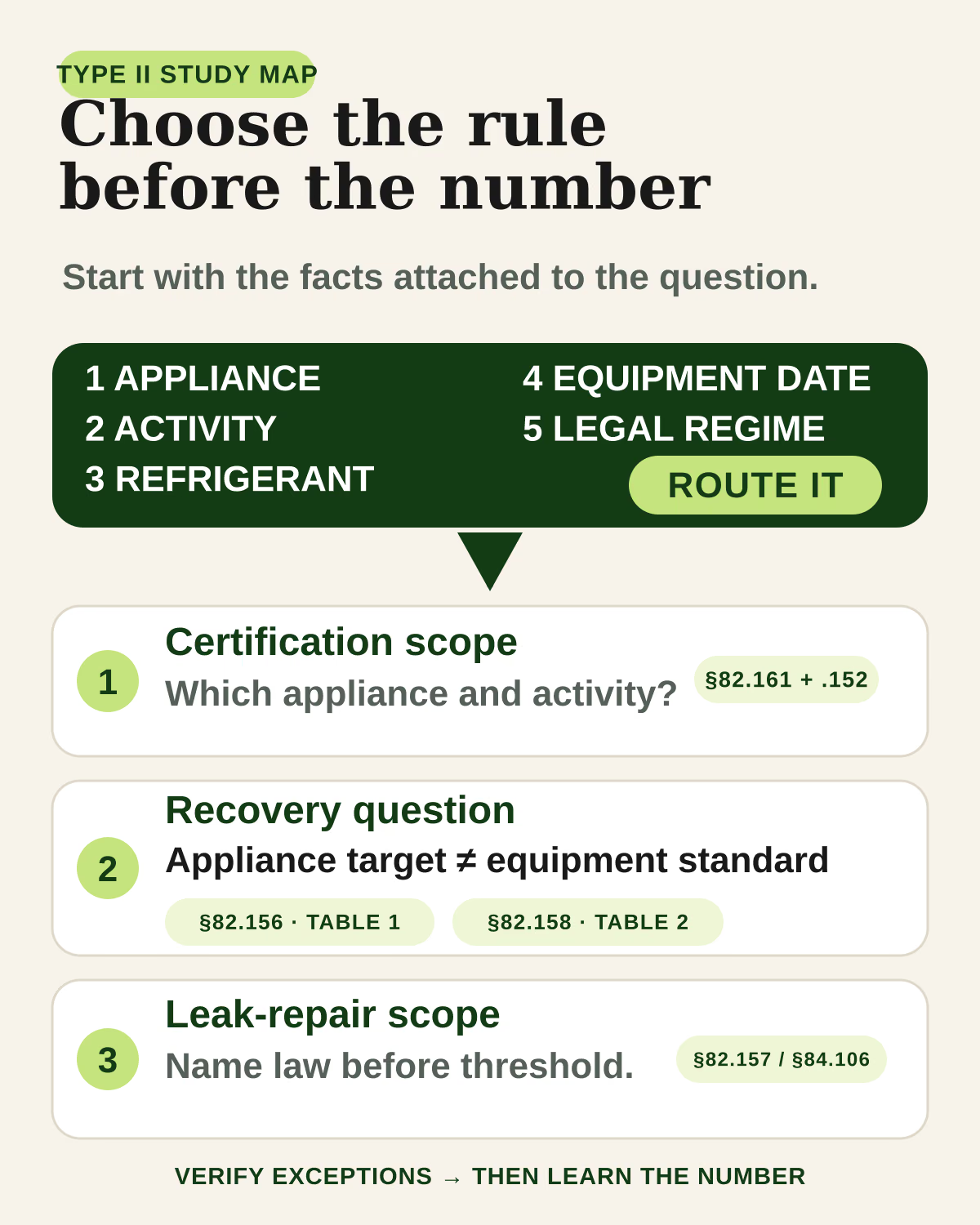
For EPA 608 Type II, learn the conditions attached to a rule before memorizing its number. Start with appliance category, activity, refrigerant, recovery-equipment date, and legal regime. Use those facts to decide which definition or requirement belongs on your flashcard.
Identify the appliance and activity
Type II’s legal scope includes medium-, high-, and very-high-pressure appliances, with exceptions for small appliances, motor vehicle air conditioners (MVACs), and MVAC-like appliances. MVAC-like service separately allows Type II or Section 609 certification. The Section 608 certification rule covers refrigerant-circuit work involving ozone-depleting refrigerants and non-exempt substitutes. 40 CFR 82.161 (opens in a new tab)
Paid or bartered MVAC service requires Section 609 certification; Type II does not replace it. EPA’s MVAC requirements (opens in a new tab)
Pressure classes depend on specified refrigerant properties, rather than a momentary gauge reading. Very-high-pressure classification also includes a critical-temperature criterion. For example, §82.152 lists R-410A as high pressure and R-23 as very high pressure. 40 CFR 82.152 (opens in a new tab)
Build a study map across the six topic groups
EPA’s public Type II outline (opens in a new tab) supplies these six groups. Study them alongside Core; the outline’s historical wording needs the current-law boundaries below.
| EPA topic group | Distinction to learn |
|---|---|
| Leak detection | Oil traces are clues; an inspection locates a leak, while verification assesses the repair. Definitions (opens in a new tab) |
| Leak repair requirements | Establish coverage and appliance use before learning leak-rate triggers, deadlines, extensions, and records. |
| Recovery techniques | Recovery speed differs from completion: pressure rebound can indicate refrigerant remaining as liquid or in oil. Study contamination prevention too. |
| Recovery requirements | Separate service from disposal, major from non-major repair, and appliance obligations from recovery-machine certification. |
| Refrigeration | Connect component roles with liquid/vapor states; distinguish gauge from absolute pressure on pressure-temperature charts. |
| Safety | Recognize oxygen-deprivation hazards and the instruction not to energize a hermetic compressor under vacuum; distinguish general hazard awareness from an installation’s equipment-room requirements. |
Keep recovery and dehydration separate
Recovery removes refrigerant for external storage. Dehydration evacuation removes air and moisture. Meeting a refrigerant-recovery requirement does not establish that dehydration is complete. Recovery definition (opens in a new tab), EPA’s Core objectives (opens in a new tab)
For recovery-number study, read §82.156(a) and Table 1 together. Record pressure class, appliance or isolated-component full charge, activity, and recovery-equipment manufacture/import date. The date columns divide equipment made or imported before November 15, 1993, from equipment made or imported on or after that date. Read the conditional exceptions for non-major repairs and leaking appliances before applying a table value. Appliance evacuation requirements (opens in a new tab)
§82.158 Table 2 addresses recovery-equipment certification performance. Its categories differ from the appliance-service table. Keep the two purposes labeled in your notes. Recovery-equipment standards (opens in a new tab)
Also distinguish system-dependent recovery, which relies on appliance components, from self-contained recovery. Study the permanent pump-out exception alongside the system-dependent equipment limit. Definitions (opens in a new tab), §82.156(e) (opens in a new tab)
Label leak-repair notes by legal regime
Section 608 - §82.157: This section covers appliances with a full charge of 50 pounds or more of Class I or Class II ozone-depleting refrigerant, including blends containing it. Appliances containing solely substitute refrigerants are outside this section. Current §82.157(a) (opens in a new tab)
AIM Act - §84.106: Requirements apply beginning January 1, 2026, to appliances with a full charge of 15 pounds or more whose refrigerant contains an HFC or a qualifying substitute with GWP greater than 53. This section excludes appliances using solely ozone-depleting refrigerant and the residential and light commercial air-conditioning and heat-pump subsector. Current §84.106(a) (opens in a new tab)
The GWP cutoff concerns substitutes; it is not a blanket exemption for refrigerants containing HFCs. EPA also identifies chillers and certain variable refrigerant flow systems as separate subsectors from the residential/light-commercial exclusion. EPA’s January 2026 fact sheet, page 1 and footnotes (opens in a new tab)
Keep separate notes for each rule’s applicability, leak-rate categories, verification, extensions, and records. Reading the two scopes together, an ODS/HFC blend can fall under both when its charge meets both thresholds. The 2020 change to §82.157 does not erase the AIM Act’s 2026 requirements. §82.157(a) (opens in a new tab), §84.106(a) (opens in a new tab)
Apply the distinctions
A factory-built appliance is factory-charged and hermetically sealed with four pounds of a non-exempt refrigerant. Does high pressure alone make its service Type II? No. It meets the small-appliance definition; Type I or Universal covers that service. §82.152 (opens in a new tab), §82.161 (opens in a new tab)
A recovery question gives the air conditioner’s installation year but omits the recovery machine’s date. Can you choose the date column? No. The columns refer to the recovery equipment’s manufacture/import date. §82.156 Table 1 (opens in a new tab)
A supermarket refrigeration appliance has a 20-pound full charge of HFC refrigerant with no ozone-depleting component. Is it outside federal leak-repair rules because it is below 50 pounds? No. It falls within §84.106’s applicability; its facts do not trigger §82.157 coverage. §84.106(a) (opens in a new tab), §82.157(a) (opens in a new tab)
Turn each uncertain distinction into a task in your study plan. This short map does not cover every Core or Type II objective, detailed compliance calculations, current equipment-room code requirements, or model-specific service procedures.
Explore the desk
Your next chapter
More study guides